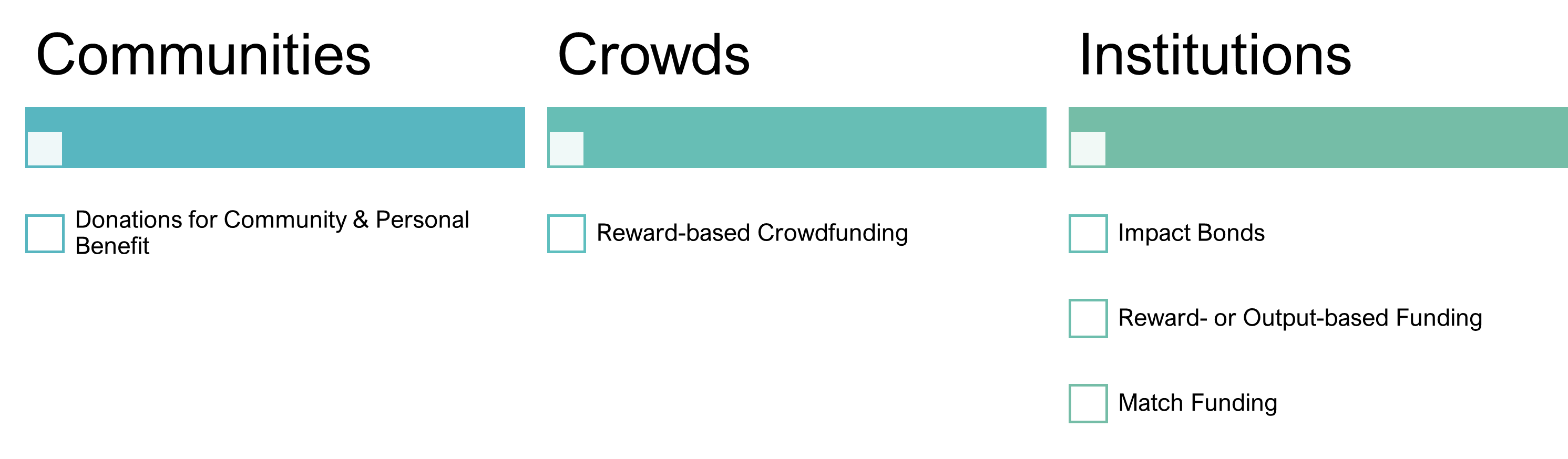
Institutional funding
This includes venture capital and bank financing but also any other funds made available by companies, charities, governments and family offices. Investments made by governments may increase confidence of other investors.
Impact bonds
When investors seek to achieve specific non-financial goals they may issue impact bonds. These are debt instruments that may operate without interest. In impact bonds the investors take on the additional risk of a project, and the government payout after the project depends on its success. These can be measurable impacts or cost-savings.
Impact bonds are an ideal way to reduce the risk for the government by letting the market take on the risk of achieving success. Examples are green bonds, related to the sustainable energy transition, or social impact bonds, related to specific social goals. Normally these impact bonds are executed by large investors due to the complexity of the proposal and conditions.
Reward or output based funding
Similar to crowdfunding, governments and NGOs that want to support a certain development, such as the rise of sustainable energy, may engage in reward-, or output-based funding. The funder can be paid back not with money, but for example with sustainable energy. This reduces the risk because no repayments are needed until the production stage is reached.
An example of this is the IDEA: the Spanish institute for energy diversification and saving. IDEA invests into a project and is repaid in units of produced sustainable energy. The monetary equivalent of every unit produced is deducted from the loan value until the full loan is repaid.[1]
Match funding
In match funding, governments or other organizations match the funding generated by other investors. It can be done in all forms of capital but the most common forms of government involvement are grants, subsidies and guarantees.[2] Governments may also co-invest in a public-private investment fund which in turn invests in projects and businesses.
[1] CrowdThermal D3.2
[2] CrowdThermal D3.2